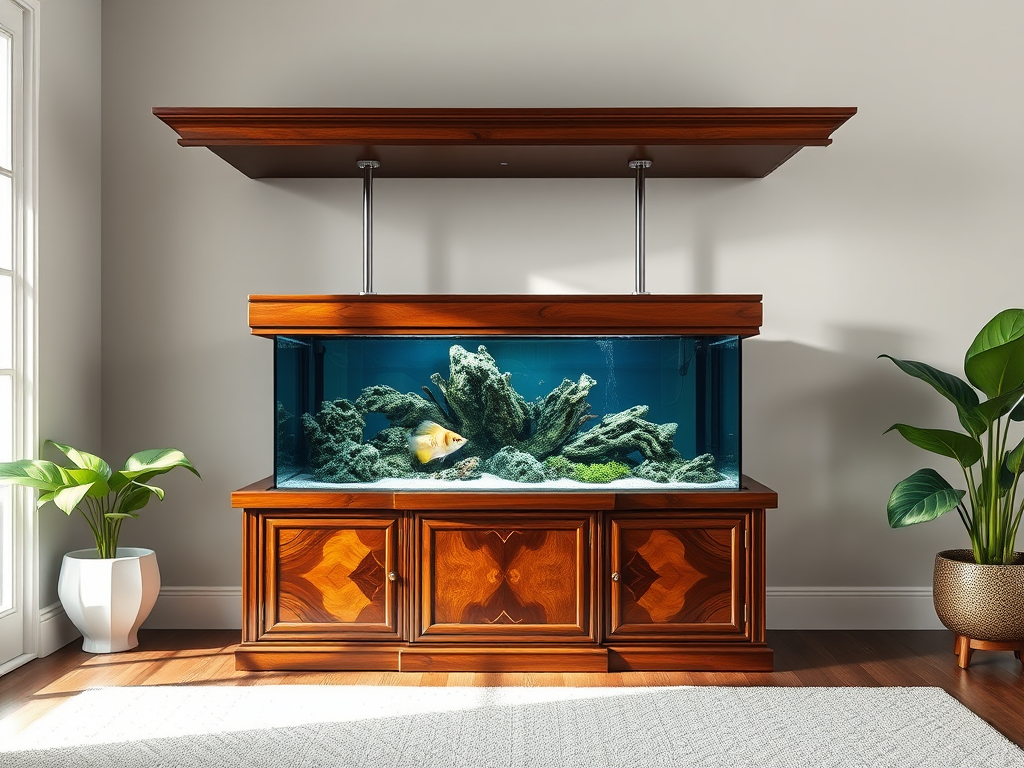
An aquarium can weigh hundreds of kilograms, and the stand beneath it is the single most safety-critical piece of equipment in the hobby. A failure of the stand does not merely damage property; it can kill fish and injure people. Yet many aquarists give the stand less thought than the filter or lighting, assuming any sturdy-looking table will do. In reality, load bearing, leveling, and material choice are engineering decisions that deserve careful attention. This guide explains how to calculate aquarium weight, choose or build a proper stand, and ensure it is level and structurally sound.
1. Calculating Aquarium Weight
Every stand decision begins with an accurate weight estimate.
- Water Weight: One liter of water weighs roughly one kilogram; a 200-liter tank holds 200 kilograms of water alone.
- Substrate and Hardscape: Rock and sand add substantial weight, easily 50 kilograms or more in large tanks.
- Glass and Equipment: The tank, filter, and equipment add further mass.
- Total Load: Add all components, then design the stand for that load with a safety margin.
2. Load-Bearing Principles
Understanding how loads transfer through a stand prevents dangerous assumptions.
- Vertical Support: Weight must be carried directly down through legs or panels to the floor.
- Corner Support: The four corners of the tank must sit over structural support.
- Avoid Chips and Particle Board: Standard particle board deforms under moisture and load; use solid wood, plywood, or metal.
3. Choosing or Building a Stand
A proper stand is engineered, not improvised.
- Commercial Stands: Choose stands rated for the tank's volume and weight, not merely matching dimensions.
- DIY Stands: Use dimensional lumber with the tank supported along its entire perimeter.
- Sealing: Seal wood against moisture to prevent rot and warping.
4. Leveling the Stand
A tank that is not level places uneven stress on glass and seams.
- Check with a Level: Verify level in both directions before filling.
- Shimming: Use shims or adjustable feet to correct minor discrepancies.
- Floor Condition: Place the stand on a solid, flat floor; carpets may need a rigid base.
5. Floor Considerations
The floor beneath the stand must handle the concentrated load.
- Structural Floors: Place large tanks across floor joists rather than between them.
- Concrete Floors: Over-slab placement is generally safest.
- Weight Distribution: Spread load across a footprint rather than concentrating it on small feet.
6. Common Stand Mistakes
Most aquarium stand failures trace to a handful of errors.
- Furniture as Stands: Household furniture is rarely rated for aquarium loads.
- Unlevel Installation: Overlooking leveling stresses seams over time.
- Moisture Damage: Unsealed wood rots and loses strength.
7. Long-Term Inspection and Safety
Even a solid stand deserves periodic inspection.
- Look for Warping: Check for sagging, moisture damage, and loosened fasteners.
- Watch Seams: Monitor silicone seams for stress created by uneven support.
- Address Promptly: Repair or replace stands at the first sign of weakness.