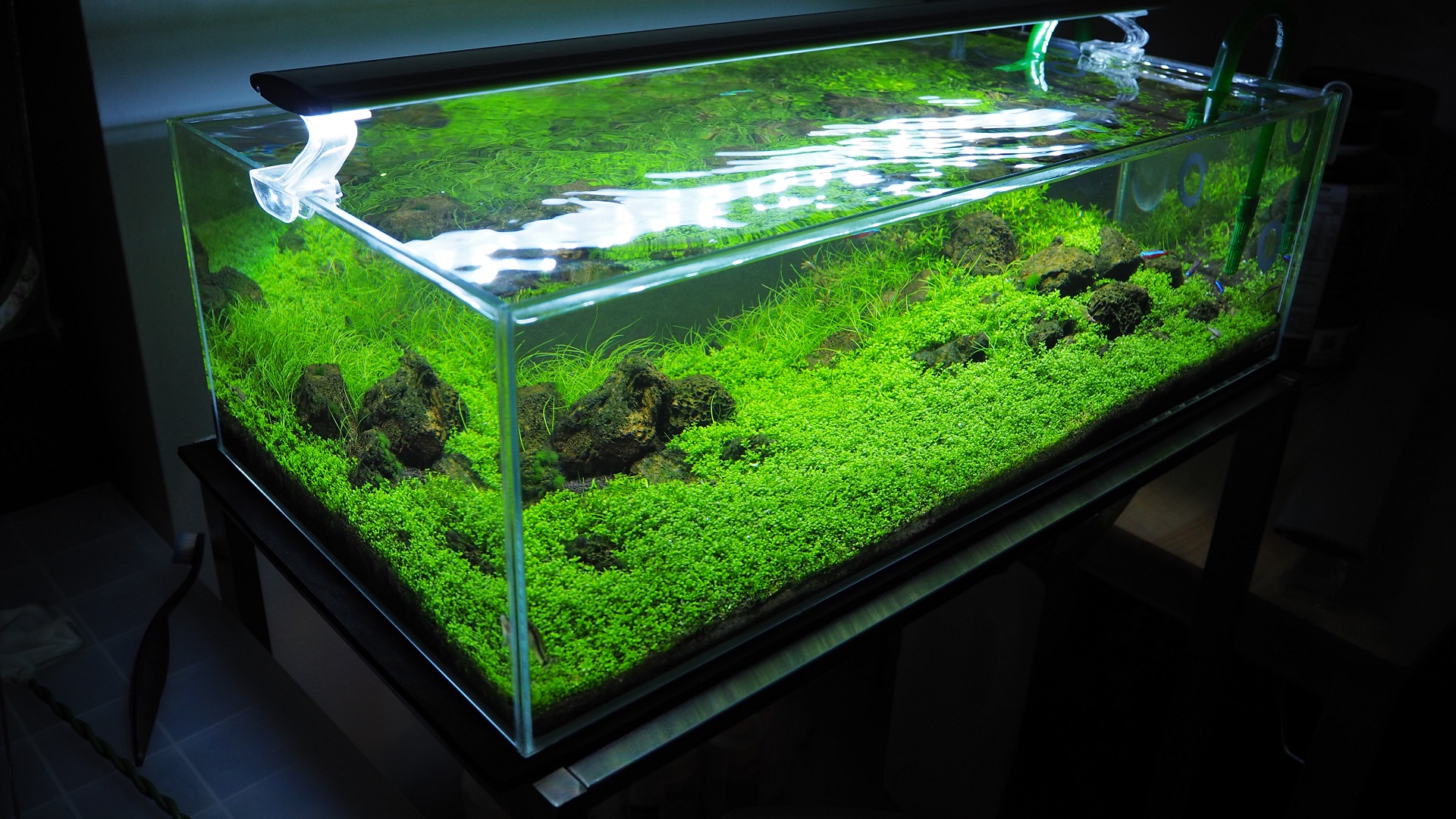
Foreground carpet plants are the crown jewels of the high-tech planted aquarium, creating a lush, unbroken "lawn" that anchors an aquascape and defines its sense of depth. Species such as Hemianthus callitrichoides (HC), Monte Carlo, and dwarf hairgrass spread horizontally across the substrate via runners, forming a dense green floor when provided with the right combination of intense light, carbon dioxide, and nutrients. Achieving a healthy carpet is a rite of passage for planted-tank enthusiasts, but it also demands an understanding of propagation, lighting, and substrate runners. This guide explains how to establish and maintain a thriving foreground carpet.
1. The Anatomy of a Carpet
Carpeting plants spread through a very different growth strategy than stems or rosettes.
- Runners: Horizontal stems called runners creep across the substrate, rooting and sprouting new leaves.
- Dense Growth: Close spacing and pruning encourage a tight, weed-free mat.
- Root Anchoring: Roots pull the carpet flat against the substrate as it fills in.
2. Selecting Carpet Species
Each carpet species has distinct demands and growth habits.
- Hemianthus callitrichoides: A tiny, demanding classic that needs strong light and CO2.
- Monte Carlo: Slightly larger and more forgiving, an excellent beginner carpet.
- Dwarf Hairgrass: A grass-like carpet that suits contrasting, naturalistic layouts.
3. High Lighting Requirements
Carpets are among the most light-hungry plants in the hobby.
- Intensity: Carpet species demand high PAR at the substrate level.
- Penetration: Ensure light reaches the substrate, not just the top of the tank.
- Risk of Algae: High light demands matching CO2 and nutrients to avoid algae.
4. CO2 and Nutrients for Carpeting
A lush carpet is almost impossible without carbon dioxide and disciplined fertilization.
- CO2 Injection: Consistent 20 to 30 ppm CO2 transforms carpet growth.
- Distribution: Ensure flow carries CO2-rich water across the substrate.
- Fertilization: Balanced macro and micro dosing prevents nutrient deficiencies.
5. Planting and Propagation
Carpets establish best when planted in small, numerous clumps.
- Divide and Plant: Separate portions into small clusters and plant them closely.
- Aquascaping Tweezers: Use fine tweezers to place each clump into the substrate.
- Initial Trim: Trimming after planting encourages horizontal rather than vertical growth.
6. Substrate Runners and Spreading
Understanding propagation lets you accelerate and guide carpet growth.
- Guiding Runners: You can gently redirect runners into bare areas to speed coverage.
- Trimming to Thicken: Regular mowing prevents yellowing at the base and promotes density.
- Patience: Even under ideal conditions, a full carpet takes several weeks to months.
7. Troubleshooting Carpet Problems
Carpets reveal imbalances quickly, making them useful diagnostic tools.
- Upward Growth: Usually indicates insufficient light, causing stems to reach upward.
- Melting Patches: Often follow CO2 fluctuation or a nutrient deficiency.
- Algae on Carpet: Signals excess light relative to CO2 and nutrients; rebalance parameters.